China’s dark factories are no longer science fiction. They are real, working facilities that signal a major shift in how goods are made and how global manufacturing may evolve in the years ahead.
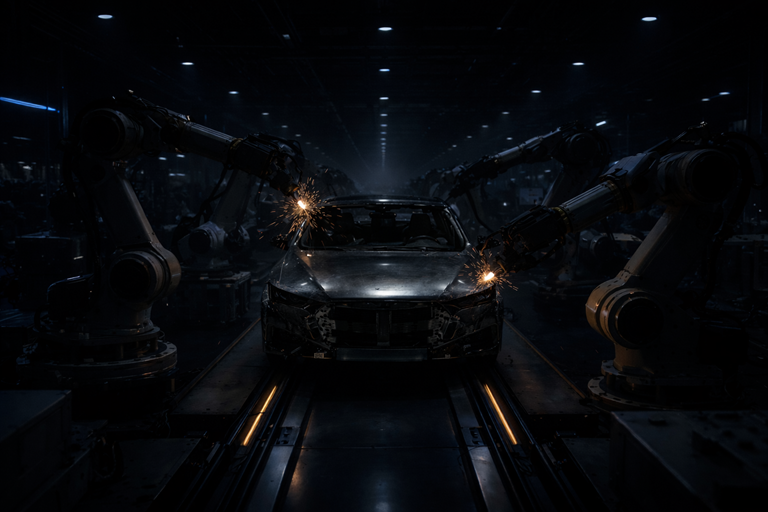
These factories are called dark because they can operate without lights. With no human workers on the production floor, there is no need for lighting, heating or other systems designed for people. Instead, robots, sensors and artificial intelligence run production around the clock in near total darkness.
What is a dark factory
A dark factory, sometimes called a lights out factory, is a fully automated manufacturing site. Machines handle every stage of production, from assembly and welding to inspection and logistics. Robotic arms carry out precision tasks, while autonomous vehicles move materials across the factory floor. Sensors and cameras guide every movement, allowing machines to operate accurately even without light.
China has embraced this model at scale. According to international robotics data, the country installs more industrial robots each year than the rest of the world combined. In sectors such as electronics, electric vehicles and precision engineering, dark factories are already producing smartphones, batteries and cars with little or no human involvement.
Why China is leading the way
Several factors explain China’s rapid adoption of dark factories. Labour costs have risen steadily, making automation more attractive. At the same time, government policy has strongly backed advanced manufacturing through the Made in China 2025 strategy. Billions have been invested in robotics, artificial intelligence and smart factory infrastructure.
Chinese firms such as Xiaomi, BYD and Foxconn have pushed automation further than most global competitors. At Xiaomi’s Changping smart factory in Beijing, robots build smartphones continuously, producing one device every few seconds. In the automotive sector, companies like Jetour and Zeekr use hundreds of robots to assemble vehicles with extreme speed and consistency.
Technology behind the darkness
China’s dark factories depend on a combination of artificial intelligence, robotics and the Internet of Things. AI acts as the brain, coordinating machines, analysing sensor data and adjusting workflows in real time. Machine vision systems inspect products for tiny defects that human eyes might miss.
Sensors and high speed networks form a constant stream of data, allowing machines to predict faults before they happen. This predictive maintenance reduces downtime and keeps production running smoothly. The result is higher efficiency, lower energy use and near perfect quality control.
What it means for jobs
The rise of China’s dark factories has raised concerns about employment. Manufacturing still employs millions of people across the country, and automation threatens many traditional roles. Economists have warned that millions of factory jobs could disappear over the next decade if automation continues at its current pace.
However, new roles are also emerging. Engineers, robotics technicians, data analysts and AI specialists are increasingly in demand. Many companies are investing in retraining programmes to help workers move into these higher skilled positions.
Will the rest of the world follow
China’s dark factories are setting a benchmark that other nations cannot ignore. Countries such as Germany, Japan, South Korea and the United States are also investing heavily in automation, though few have reached the same level of scale.
While fully dark factories remain rare outside China, elements of the model are spreading quickly. As costs fall and technology improves, more manufacturers are likely to adopt lights out production in high value industries.
China’s dark factories show a possible future for global manufacturing. Whether other countries follow at the same pace will depend on economics, politics and how societies adapt to a world where machines do most of the work.