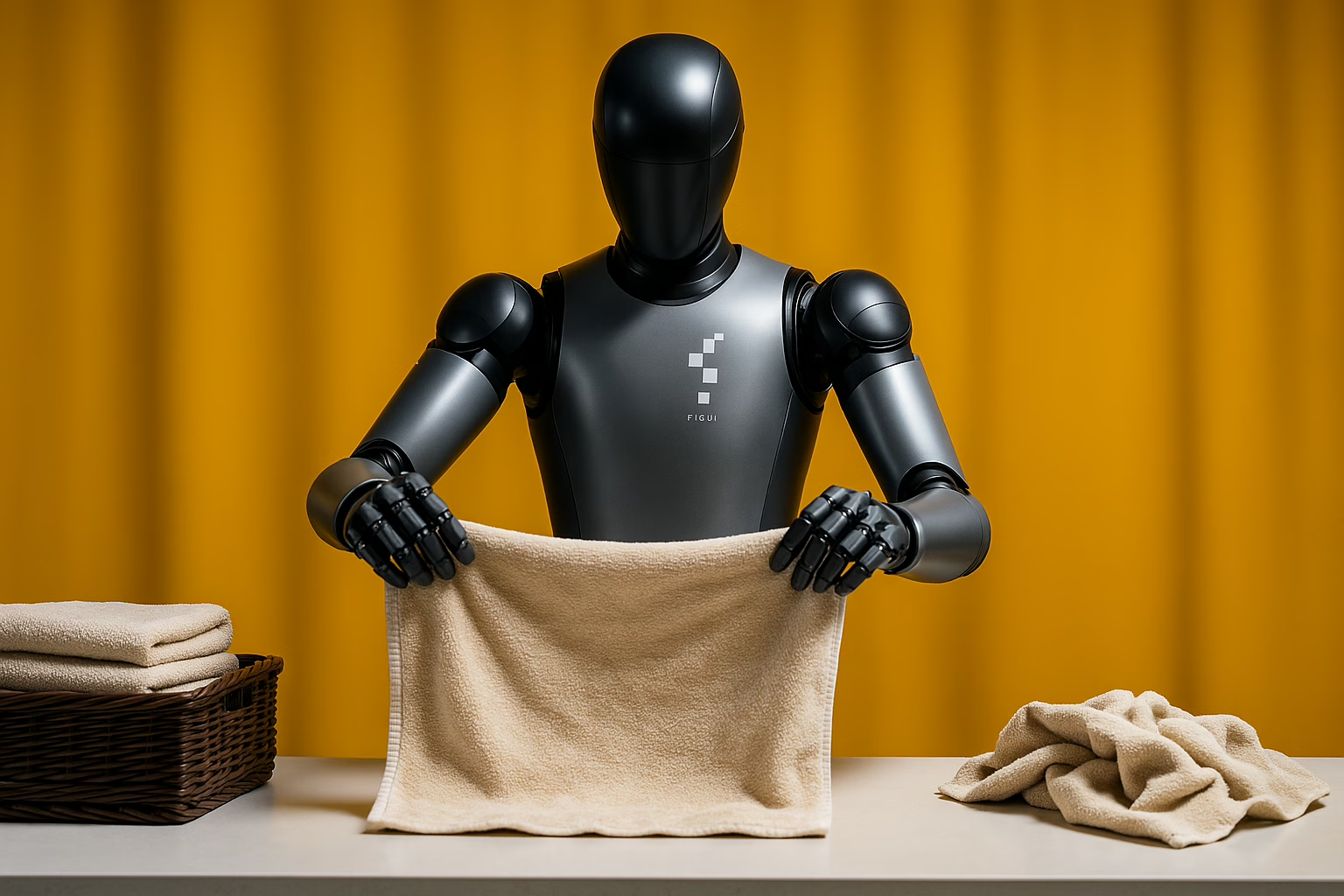
Folding laundry might not sound like a breakthrough, but for robots, it’s one of the toughest challenges around. Now, a humanoid robot named Helix, developed by US robotics firm Figure, has done just that, neatly folding towels on its own using the same AI system it once used to sort packages in warehouses.
Helix’s demonstration, shared online by Figure, shows the humanoid carefully lifting towels from a pile, smoothing them out, and folding them into tidy squares. The movements are deliberate and adaptive, with small corrections and gentle gestures that make the process look remarkably human.
Why Folding Laundry Is So Hard for Robots
To most people, laundry is just another household chore. For machines, it’s a scientific nightmare. Towels don’t hold a fixed shape – they flop, wrinkle, and tangle. Grasping one corner incorrectly can cause the whole thing to twist or fall. Robots, which usually excel at handling rigid objects like boxes or tools, struggle with anything soft and unpredictable.
Helix’s achievement marks the first time a humanoid robot with multi-fingered hands has folded laundry fully autonomously using an end-to-end neural network. This means that the same system controlling its vision, understanding, and movements handles the entire task – from seeing the towel to placing the final fold – without human intervention or step-by-step programming.
The Brain Behind the Robot
At the heart of Helix is Figure’s Vision-Language-Action (VLA) model, a type of artificial intelligence that combines seeing, understanding, and doing. It allows Helix to interpret spoken commands, process visual information, and act on it in real time.
Crucially, the model that learned to sort packages in a logistics warehouse is exactly the same one that now folds laundry. No changes were made to the architecture or training setup; the only difference was a new dataset showing examples of towels and folding actions. This demonstrates how flexible and general-purpose Helix’s system has become.
Helix can even recover from mistakes, such as picking up two towels at once, by placing one back before continuing. It also performs delicate moves – tracing a towel’s edge with its thumb or pinching a corner – with precision that would have seemed impossible just a few years ago.
A Step Toward Everyday Robotics
Figure says this breakthrough highlights how a single AI model can handle vastly different environments, from industrial logistics to domestic chores. The company hopes that as Helix collects more real-world data, its dexterity and adaptability will continue to improve.
Beyond technical skill, Helix also interacts naturally with people, maintaining eye contact and using simple hand gestures during tasks. This kind of social awareness, while subtle, makes robots feel more approachable and easier to work alongside.
What This Means for the Future
While Helix folding towels may seem like a novelty, experts say it represents an important milestone. By showing that one AI system can move seamlessly between jobs, Figure is pushing robotics closer to the long-promised vision of general-purpose humanoids – machines that can help both at home and at work without extensive reprogramming.
For now, Helix’s handiwork might only save you from folding towels. But tomorrow, the same intelligence could be setting tables, packing deliveries, or assisting in hospitals, quietly learning from each task, one fold at a time.