Norwegian robotics company 1X Technologies has announced Redwood, a new artificial intelligence model designed to power its humanoid robot platform, NEO Gamma. Unlike most humanoid firms that first focus on industrial settings, 1X has taken a bold step straight into the home, creating a robot designed to help with everyday tasks such as opening doors, fetching objects, and navigating cluttered rooms.
Redwood represents a major leap in robotics design: a vision-language transformer purpose-built for humanoids. It enables NEO Gamma to see, understand and act within complex home environments, all while running entirely on the robot’s onboard hardware.
What makes Redwood different
Where many AI systems rely heavily on cloud computing, Redwood is notably small and self-contained, with just 160 million parameters – tiny compared to the multi-billion-parameter models behind most modern AI. Yet it packs remarkable capability into this compact form.
The model’s size means it can run locally on NEO’s embedded GPU, without needing a constant internet connection. That allows it to operate in basements, gardens, or homes with unreliable Wi-Fi, an essential feature for true autonomy. The onboard setup also enhances privacy and security, keeping all sensor data within the robot itself.
1X says Redwood’s efficiency stems from how it learns: it is trained not only on successful tasks, but also on failures, helping the robot improve from every experience. This “learn-from-everything” approach is key to building reliable behaviour in the unpredictable world of human homes.
Seeing, thinking, and moving as one
What sets Redwood apart technically is its fully integrated vision system. The model combines information from three sources:
- Vision tokens from a pre-trained visual transformer, giving the robot detailed perception of its surroundings.
- Language embeddings, allowing NEO to interpret spoken instructions.
- Proprioception data, signals from the robot’s joints and sensors that tell it how its body is positioned.
These streams are fused within Redwood’s cross-embodiment architecture, which allows a single model to control both the bipedal NEO Gamma and 1X’s earlier EVE platform. The result is a seamless blend of sight, movement, and reasoning, enabling whole-body coordination similar to that of humans.
Whole-body and mobile manipulation
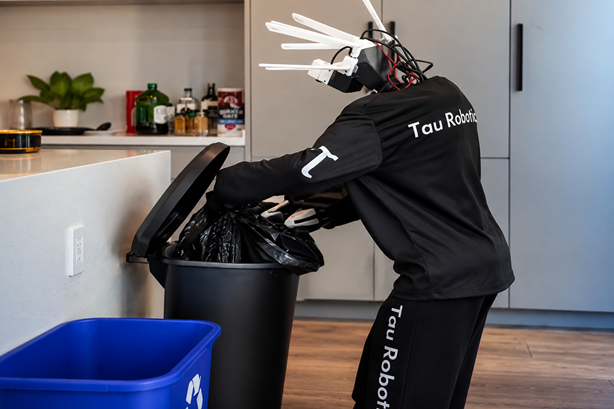
In most robots, movement and manipulation are separate systems. Redwood, however, unifies them. It can predict commands not just for the hands and arms, but also for legs, hips, and torso, allowing NEO Gamma to lean into doors, crouch to pick up toys, or brace against walls when lifting heavier items.
This approach, known as multi-contact manipulation, gives the robot a much broader range of motion and the ability to interact with its environment in a more natural, human-like way.
Smarter, smaller, and ready for the real world
By running entirely onboard, Redwood gives 1X’s humanoid a clear edge in flexibility and deployment. There’s no need for powerful external servers or constant connectivity, just the robot, its sensors, and a modest embedded GPU.
Eric Jang, 1X’s Vice President of AI, describes Redwood as “one of the first end-to-end mobile manipulation systems for biped humanoids”, emphasising that the model’s compact design was a deliberate choice.
As 1X prepares to roll out the NEO Gamma platform, Redwood marks a crucial step toward making truly autonomous household robots a reality – intelligent, capable, and small enough to think on their feet.