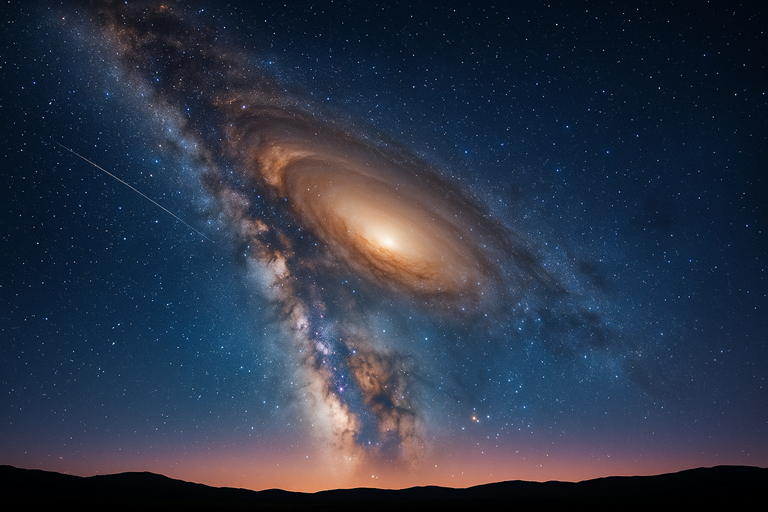
Researchers in Japan, Spain and the UK have created the most detailed digital model of our galaxy ever attempted, offering scientists a new window into how the Milky Way formed, evolved and continues to change. The project, led by Keiya Hirashima at the RIKEN Center for Interdisciplinary Theoretical and Mathematical Sciences, has produced the first simulation capable of tracking more than 100 billion individual stars over ten thousand years of galactic activity.
Why Simulating the Milky Way Is So Hard
For decades, astrophysicists have aspired to build a true digital twin of our galaxy. Such a model would allow researchers to test theories about star formation, supernova activity and the long term evolution of the Milky Way by comparing simulated results to real observations.
Until now, this goal has remained out of reach. Simulating a galaxy requires keeping track of gravity, gas behaviour, chemical changes and explosive events across vast scales. The smallest simulations available previously could manage the equivalent of about one billion stars. To save computing power, each particle in those models represented around 100 real stars. This averaging smoothed out vital details, meaning that individual supernovae or small scale gas flows could not be represented accurately.
The challenge grows as the models attempt to capture quick events. Supernova explosions unfold rapidly, so simulations need very small time steps to track them. Reducing the timestep creates a huge increase in computational effort. Using purely physics based models, simulating one million years of Milky Way activity would require 315 hours of real computing time. A billion year run would take more than three decades. Adding more supercomputer cores is not a practical solution because efficiency falls sharply and energy consumption becomes excessive.
A New Blend of AI and Physics
Hirashima and his colleagues overcame these obstacles by combining traditional physics simulations with a deep learning surrogate model. The AI was trained using high resolution simulations of supernovae and learned to predict how gas spreads through space during the hundred thousand years following an explosion.
This means that the AI can take care of the rapid, small scale processes without slowing down the main simulation. The researchers validated the approach using tests on RIKEN’s Fugaku supercomputer and The University of Tokyo’s Miyabi system.
The result is a model that captures the movements and interactions of more than 100 billion stars at true individual star resolution. Crucially, it does this at speed. Instead of taking 36 years, simulating a billion years now takes around 115 days. A million years of activity can be generated in just under three hours.
What Scientists Have Learned
The new simulation offers a fresh view of how individual supernovae shape the galaxy. These explosions spread heavy elements into surrounding gas clouds, influencing the chemical make up and future star formation within the Milky Way. With individual events now visible in detail, scientists can trace how the building blocks of life may have emerged.
The model also reveals how short term and long term processes connect. Small scale events, once hidden in previous simulations, can be seen influencing the large scale structure of the galaxy.
What Happens Next
The team believes this approach could transform many areas of science. Climate research, ocean modelling and weather forecasting all involve a similar challenge of linking small scale physics to global behaviour. With further development, AI assisted simulations could become central tools in these fields.
For astronomy, the next step is to extend the simulation across far longer timescales and to explore different types of galaxies. Researchers hope that by doing so they will be able to test long standing theories about how the Milky Way was born and how it will evolve in the future.
Hirashima says the breakthrough marks a shift in how science can be done. By combining artificial intelligence with high performance computing, researchers can now model the universe in unprecedented detail, opening the door to discoveries that were previously impossible.