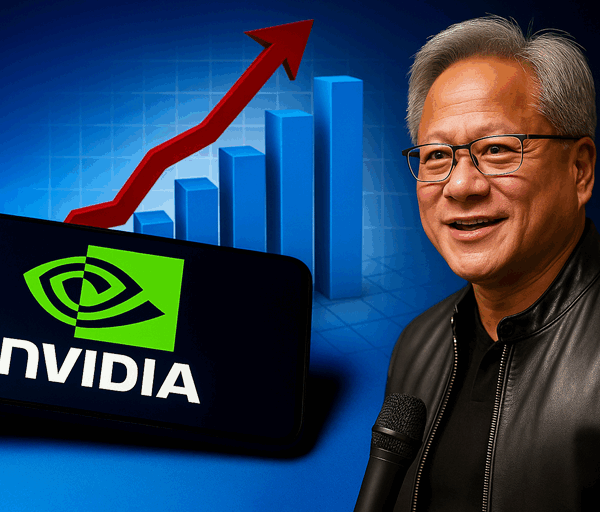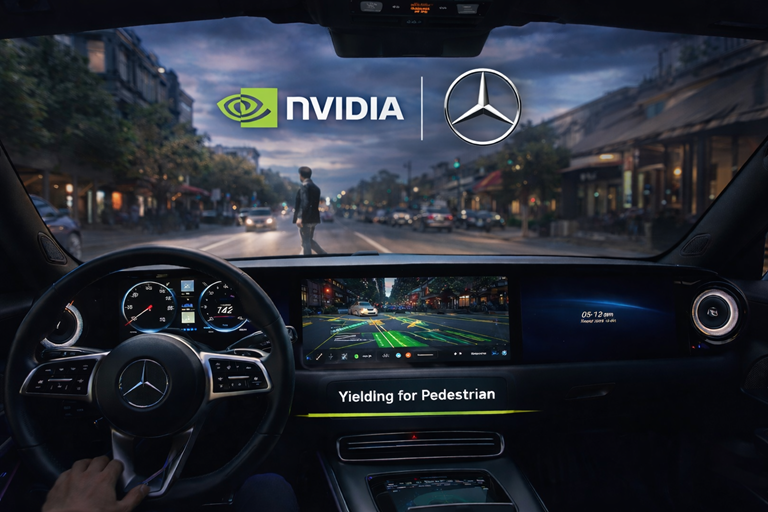
Nvidia and Mercedes took centre stage at CES 2026 in Las Vegas, unveiling new artificial intelligence technology designed to accelerate the move towards autonomous driving. The announcement, delivered by Nvidia chief executive Jensen Huang, helped push Nvidia’s share price higher and reinforced the company’s growing influence beyond data centres and into real world transport.
The focus of the announcement was Alpamayo, a new family of AI models built to help vehicles reason through complex driving situations. Nvidia says the system has been trained on millions of miles of synthetic driving data before being tested on real roads, allowing it to handle rare and unpredictable scenarios more safely.
How Alpamayo works
Alpamayo is built on Nvidia’s Cosmos foundation model and combines vision, language and action based reasoning. Rather than simply reacting to sensor input, the system evaluates what is happening around the vehicle and decides the most appropriate action to take.
According to Nvidia, this approach is designed to help cars cope with real world problems such as unexpected road layouts, traffic light failures or unusual pedestrian behaviour. Huang described it as a step towards giving machines a form of physical common sense.
The technology forms part of Nvidia’s wider push into what it calls physical AI, where artificial intelligence is applied to machines that move and interact with the real world.
Mercedes brings AI to the road
Mercedes will be the first carmaker to deploy Alpamayo in a production vehicle. The AI system will be integrated into the new CLA model, the first Mercedes vehicle to run on the company’s MB.OS software platform.
The car has already achieved a five star Euro NCAP safety rating and is due to arrive in US showrooms in early 2026, with European sales following later in the year. Nvidia says the rollout marks one of the most advanced uses of AI driven driver assistance in a consumer vehicle to date.
Other companies, including Jaguar Land Rover, Lucid and Uber, have also confirmed plans to adopt Nvidia’s autonomous driving platform.
Beyond cars and transport
During his CES keynote, Huang said autonomous vehicles are only the beginning. He argued that the same technology could underpin robots, logistics systems and future industrial automation.
Nvidia also revealed its new Rubin AI computing platform at CES, designed to deliver far more processing power at lower cost. The company believes this will be essential to supporting the massive computing demands of autonomous systems and large scale AI models.
Analysts attending CES said the announcements underline why Nvidia remains central to the global AI boom, with autonomous driving and robotics seen as major long term growth areas.
Why Nvidia and Mercedes matter
The partnership between Nvidia and Mercedes highlights how traditional carmakers are increasingly relying on technology firms to deliver advanced software and AI capabilities. As vehicles become more software defined, the role of companies like Nvidia is expected to grow.
With regulators, consumers and manufacturers all focused on safety, reliability and trust, Nvidia and Mercedes are positioning their collaboration as a key step towards making autonomous driving a practical and scalable reality.