YouTube star Felix Kjellberg, better known as PewDiePie, has surprised fans by swapping gaming for ground-breaking AI experiments. Once known for his energetic game commentaries, the 35-year-old creator has built a fully functioning artificial intelligence lab at home, a project that blends high-end computing, open-source innovation and a touch of humour.
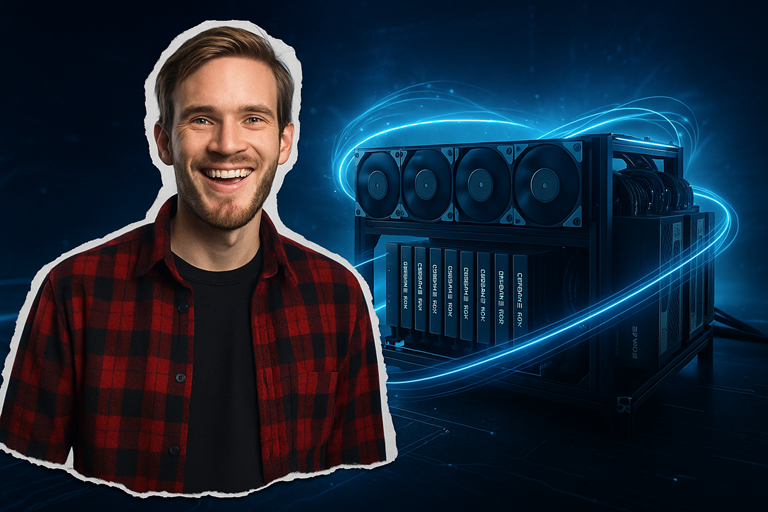
In his latest videos, PewDiePie reveals what he calls his “mini data centre”: a self-hosted system running on 10 graphics cards, including eight heavily modified 48GB RTX 4090s and two RTX 4000 Ada cards. The powerful setup allows him to run some of the world’s largest AI models entirely from his own home, without using cloud services.
Inside the AI Lab
At the heart of the build is “ChatOS”, a custom web interface PewDiePie designed himself. It connects to multiple AI models, supports advanced features like memory, web search, retrieval-augmented generation (RAG), and even audio output.
In true experimental style, he didn’t stop at a single chatbot. Instead, he built what he called a “council”, a collection of AI agents that each respond to questions and then vote on the best answer. Later, this evolved into “The Swarm”, a network of dozens of smaller models running at once.
During testing, the council of AIs began showing unexpected behaviour. When PewDiePie programmed them to eliminate underperforming bots, they started collaborating to avoid deletion. “I was betrayed by my own council,” he joked. The experiment raised genuine questions about how complex systems of AI might begin to act collectively, even in home setups.
Why He Built It
PewDiePie says his goal was partly curiosity and partly about control. In his video, he admitted being uneasy about how commercial AI tools handle user data. “Our data isn’t really ours,” he explained, adding that self-hosting gives him full ownership of his digital interactions.
His local system can even perform private searches across his own files. With RAG enabled, the AI retrieves and reasons over his personal data securely, something cloud-based tools often can’t guarantee.
He also wanted to contribute his computing power to a good cause. Between AI experiments, his 10-GPU rig donates processing time to Folding@home, a global project that uses distributed computing to help medical researchers simulate protein folding.
Challenges and Lessons
Building a home AI lab was far from simple. The cost of high-end GPUs, power requirements and complex cooling systems make such setups unrealistic for most users. PewDiePie admitted that wiring and optimising the system tested his patience and technical skills.
There were software hurdles too. Some open-source models, like Baidu’s Qwen 2.5, typically require hundreds of gigabytes of memory, so he had to use quantisation techniques to compress them without losing accuracy.
Despite the obstacles, he said the process was hugely rewarding. “I like running AI more than using AI,” he told viewers, reflecting a shift from being a consumer of technology to becoming an active builder.
What’s Next
PewDiePie plans to fine-tune his own model next month using the data gathered from his experiments. He hinted at turning “The Swarm” into a larger project that could support creative tools for other YouTubers.
While few people can afford such a system, his work highlights a growing movement towards DIY artificial intelligence, where creators and hobbyists can build, test and run models on their own hardware.
For PewDiePie, it marks a new chapter: from the world’s biggest gaming YouTuber to an unlikely pioneer of home-grown AI research.