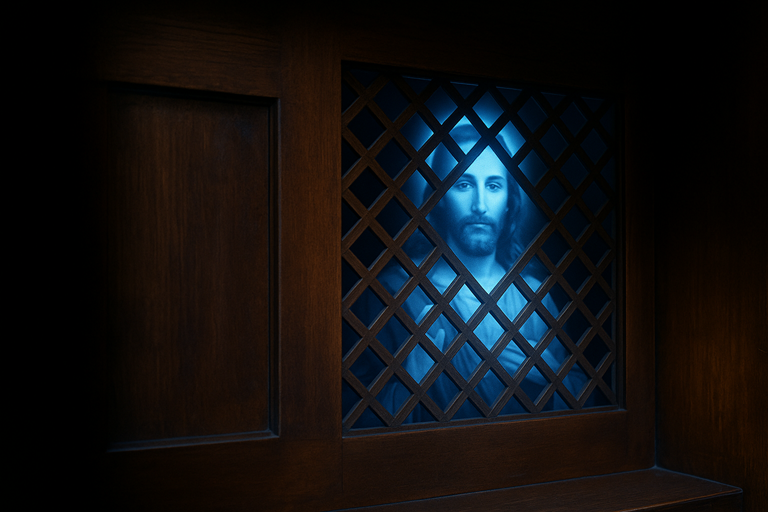
A historic chapel in Lucerne, Switzerland, has become the centre of global debate after unveiling a digital Jesus powered by artificial intelligence. Installed within a traditional wooden confessional booth, the AI figure listens and responds to visitors in more than 100 languages. The project, called Deus in Machina, was created in partnership with researchers at Lucerne University of Applied Sciences and Arts to study how people engage with AI in spiritual settings.
More than 1,000 people have already stepped inside the booth, where a softly illuminated holographic Jesus appears behind the customary mesh screen. Visitors can speak freely, pose personal questions or simply explore the technology. According to church officials, around two thirds of participants reported having what they described as a spiritual experience.
How the AI Jesus Works
The system functions much like popular voice controlled chatbots, drawing on a large language model trained on theological texts and contemporary reasoning abilities. Users speak into a microphone and the AI generates a spoken response while animating the face of Jesus in real time. The intention is not to recreate a sermon or grant absolution, but to offer reflective, empathetic dialogue.
Questions range from the existential to the deeply personal, including what happens after death or how to rediscover peace. The responses aim to be thoughtful and non judgemental. While the full training dataset has not been publicly disclosed, developers say the goal is to provide answers grounded in scripture without enforcing doctrine.
Public Response and Debate
Reactions to Deus in Machina have been mixed. Some visitors described the experience as unexpectedly moving, noting that they instinctively lowered their voices in the booth, as though speaking to a real confessor. Others felt the answers were too generic or found the concept unsettling. A small number of critics within religious circles argued that using sacred imagery in an experimental context risks trivialising faith.
Despite the controversy, many have praised the installation for encouraging new forms of reflection. Journalists observed that visitors often stayed longer than expected, returning with more questions or lingering to process the interaction.
Why the Church Created It
The project was not designed to replace priests or act as a spiritual authority. Instead, researchers and church leaders wanted to explore how modern technology may shape religious engagement. Younger generations are increasingly accustomed to asking difficult, intimate questions online rather than in person. By placing an AI system inside a functioning chapel, the team hoped to observe how people respond when digital tools enter traditionally sacred spaces.
The installation forms part of a wider international trend in which religious institutions experiment with artificial intelligence. Buddhist temples in China have tested chatbot monks, while synagogues and Islamic scholars elsewhere are exploring AI assisted educational tools.
Looking to the Future
Deus in Machina remains open with no planned end date, allowing researchers to continue studying how people of different ages, backgrounds and beliefs interact with the digital figure. For now, St Peters Chapel serves both as a place of prayer and a laboratory for understanding what spiritual encounters might look like in a technologically driven world.
Whether the AI brings clarity, comfort or simply more questions depends on the person sitting in the booth, waiting for the gentle glow of the digital Jesus to reply.